The eternal "La Traviata" again on the Opera stage
News публикувана на: 20.05.2021
 Go back
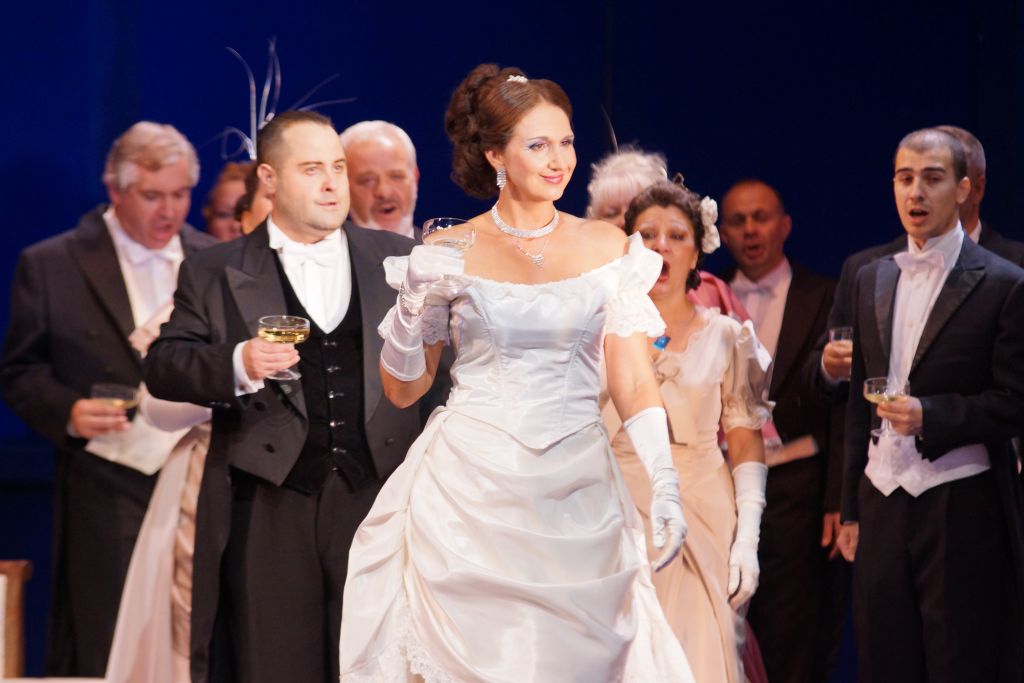
On May 28 at 7 pm in the stylish "blue" production of the opera "La Traviata" by Giuseppe Verdi of the State Opera-Stara Zagora of the beloved and popular Verdi title, the audience will see the soloists Desi Stefanova, Emilia Djurova, Ivaylo Yovchev, Ivan Kabamitov, Marin Rusinov, Alexander Marulev, Evgeny Arabadzhiev, Ignat Zhelev, Khristiana Hristova, Kostadin Yakshev, Bogomil Rusenov, the choir, orchestra and ballet of the State Opera-Stara Zagora. The conductor is Arnaud Perrier /France/. Director is Frank-Bernd Gottschalk, artist - Boris Stoynov, choreographer - Andreas Pesler.
"The Lady with the Camellias" is the work with which Alexandre Dumas - son remains in the world literature. He wrote this novel at the age of 24, its staging on stage was an extraordinary success, and the popularity of Dumas Jr. reached its peak. As the author himself says - "it is an extraordinary story" . Because it is true!
In 1844, the young Dumas met the twenty-year-old Alphonsine Plessis, known as Marie Duplessis, at the opera. By this time she was already a popular and favoured companion in Paris. The writer falls in love with her, but his feelings are conflicted - he finds it difficult to share Marie, who refuses to give up her way of life. She loved Dumas, but she also loved the money her other lovers brought her. She couldn't give it up, or them. Caught in the trap of his feelings, Dumas both loathed and adored her. He wanted to forget her, but just two days without her seemed an eternity. At one point he decided that his honour was dearer than his love, and he had to part with her, sending her a short letter: 'My dear Marie, I am neither rich enough to love you as I would wish, nor poor enough to be loved as you would wish. Therefore let us both forget-you a name which is probably indifferent to you, I a happiness which is impossible to me."
He could not forget the Lady with the Camellias, nor she him. Three years after their acquaintance Marie died of tuberculosis. The thought of her death devastated Dumas. To seal her image, he isolated himself from people, shut himself in his home, and in less than a month wrote The Lady with the Camellias. He hoped, through his work, to atone for his guilt towards her, as well as to part with his remorse. The image of the courtesan Marguerite Gautier , which Dumas Jr. created, is charming and attractive. She allows herself the "luxury" of falling truly in love. Her relationship with the young Armand is at once romantic and dramatic. Their love is impossible and doomed because it clashes with the ways of society, with pragmatism and reality.
History of the opera's creation
Verdi became acquainted with Alexandre Dumas, Jr.'s notorious novel in 1848, when it was printed. He immediately had the idea of writing an opera based on the story. And when in 1852 the composer saw in Paris the novel The Lady with the Camellias reworked into a drama, he commissioned his regular literary collaborator Francesco Maria Piave to write the libretto. Naturally, the content of the drama was rendered in abbreviated form, the names were changed, even the title - Traviata / The Lost One, The Wayless One/.
The premiere of the opera took place on 6 March 1853 in Venice and is a model in the history of colossal failures. In a letter dated 7 March c.e. "Last night La Traviata suffered a fiasco. Time will judge whether the fault lies with me or with the singers." The reason for this failure lies neither in the music nor in the libretto. Unfortunately, the singers have not proved themselves up to the standard of Verdi's wonderful work. But like a wise man, Verdi does not even look for the reasons for this failure. He simply lets time take its course. And time has ruled! Soon the opera La Traviata became Verdi's most popular opera. Camellias became the most fashionable flowers of the age and remained so until the end of the 19th century. A bouquet of them cost 250 francs - an impressive sum for its time. Gradually the fame of camellias declined, but not that of the opera. La Traviata is still performed in theatres all over the world to this day, almost 160 years after its creation.Dumas was right when, after listening to La Traviata, he said: 'In fifty years no one would remember my Lady with the Camellias, but Verdi immortalised it.
"La Traviata was one of the first operas performed by the Opera Society in Bulgaria. The premiere took place in 1910 under the baton of Todor Hadjiev. The director was K.I. Mihajlov- Stoyan.
The first performance of the opera "La Traviata" in Stara Zagora was on June 30, 1928 with conductor Alexander Georgiev, director Dimitar Hristov, artist G. Karl. There followed premieres in 1944 and 1946 and 1953 with conductor Romeo Raychev, in 1974 with conductor Veselin Nenov and director Georgi Petrov, on October 1, 1987 was the premiere of "La Traviata" with conductor Bozhidar Bonev and director Boleslav Yankovsky, on April 2, 1992 was the conductor-stage manager Dimitar Dimitrov and director - Evgenia Raeva, and the last one so far - in 2000. directed by Nina Naydenova and conducted by Bozhidar Bonev.
Now you will see the last premiere of La Traviata from 2011.