A grand ceremony marked the 100th anniversary of the State Opera - Stara Zagora
News публикувана на: 02.07.2025
 Go back
Mayor Zhivko Todorov: "This is the institution that manages to preserve the spirit of our city, manages to show that Stara Zagora is a city with a rich and inspiring cultural life"
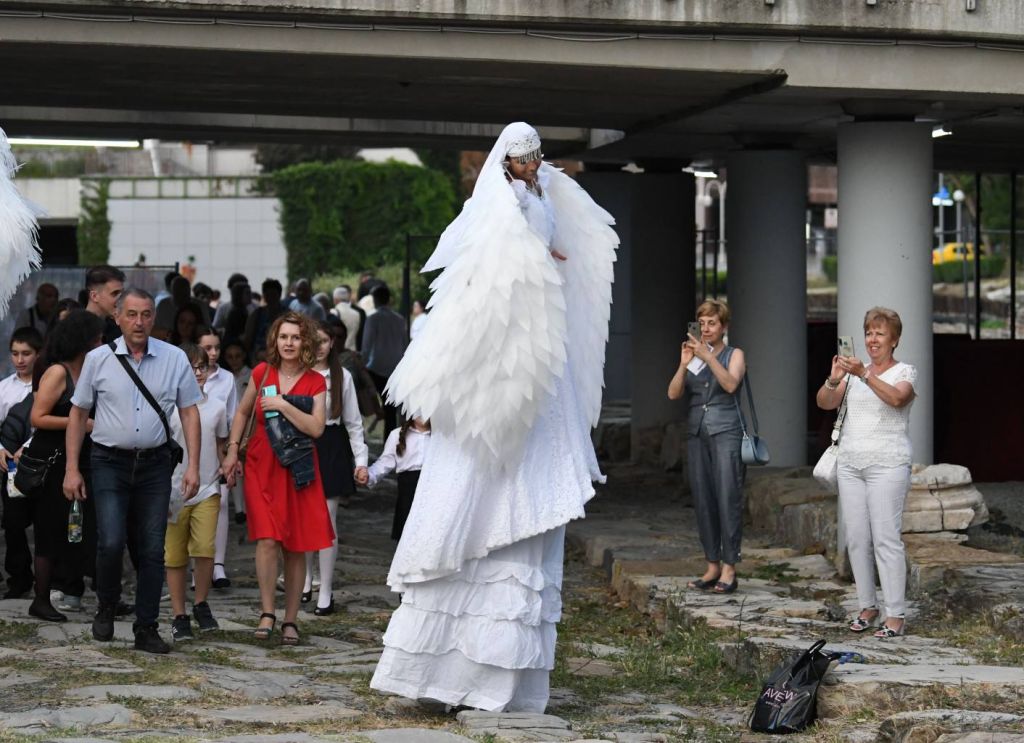
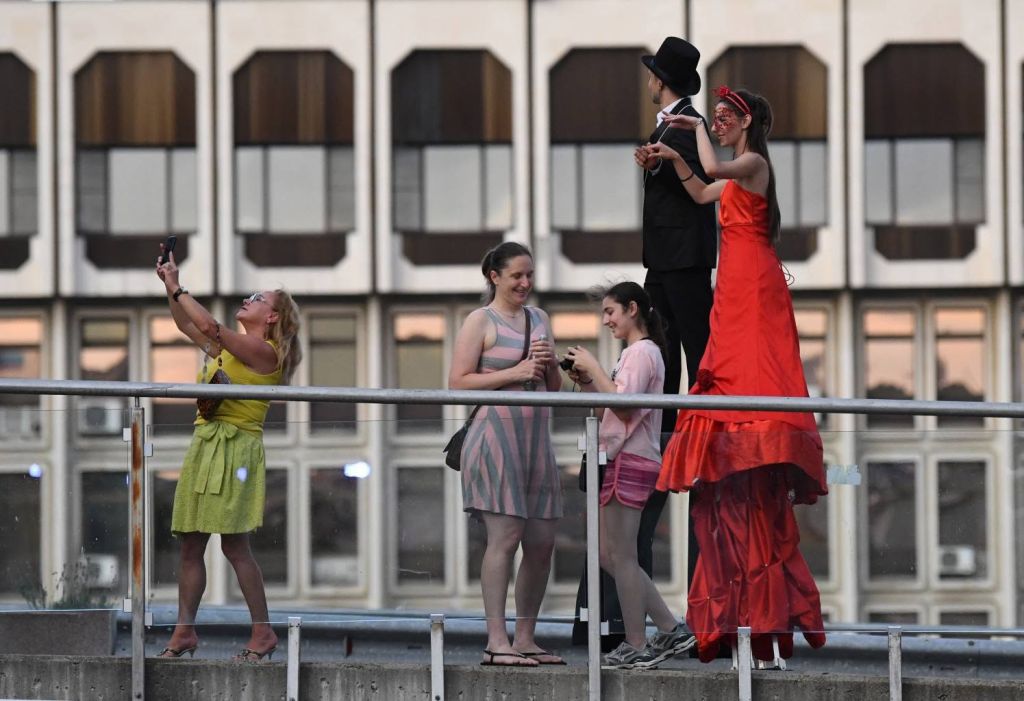
The 100th anniversary of the establishment of the State Opera - Stara Zagora was celebrated with a grand ceremony in the Antique Forum "Augusta Traiana". The event was accompanied by a gala performance and huge interest from Stara Zagora citizens and guests.
"This is the institution that manages to preserve the spirit of our city, manages to show that Stara Zagora is a city with a rich and inspiring cultural life. When I talk about the State Opera - Stara Zagora, I can not help but mention the phrase "Unification makes the strength" or, as Levski said, "To be equal to other European nations depends on our united efforts," said the Mayor of Stara Zagora Zhivko Todorov in his speech at the official opening.
With gratitude and pride, he mentioned the names of two people who are no longer with us, but were at the heart of the tremendous work done to rebuild the Opera House after it burned down in the 1990s. These are the mayors of Stara Zagora Dr. Evgeny Zhelev and prof. Svetlin Tanchev. Zhivko Todorov expressed his appreciation to all those who have supported the Opera House and contributed to its development. He congratulated the Opera team for their dedicated work and wished them many more creative successes and anniversaries.
The President of the Republic of Bulgaria Rumen Radev was among the official guests at the event. "It is a privilege to celebrate together the 100th anniversary of one of the most important cultural institutions not only of Stara Zagora, but also of Bulgaria. Since its establishment, the opera has not stopped writing history and establishing Stara Zagora as a musical and cultural centre," Radev addressed the audience.
"It is a real pleasure for me and my wife to be again among the hospitable Stara Zagora audience and to be part of your celebration. It is my duty as the Head of State to express my deep respect and appreciation to the incredible creative team of the State Opera - Stara Zagora - a bearer of a centuries-old tradition, an example of professionalism and dedication to art and to the cultural development of the city," Rumen Radev said during the opening ceremony. "It should be noted that over all these years some of the most talented Bulgarian artists have had their names inextricably linked to this opera. I wish everyone much inspiration, worldwide success and recognition, and most of all the love of this incredible audience, because it remains truly the most important recognition," the President said and congratulated all the veterans, current artists and the entire creative team.
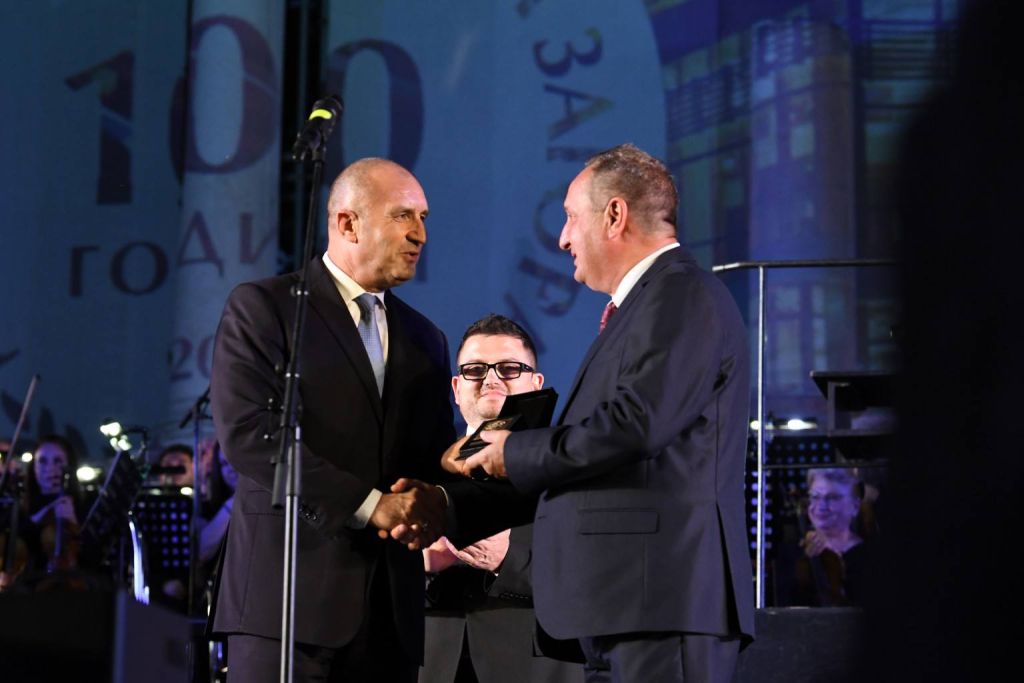
President Rumen Radev honoured the Stara Zagora Opera with the President's Badge of Honour. The award was presented for the significant achievements of generations of artists and creators from the State Opera - Stara Zagora on the most emblematic national and international stages, as well as for its key contribution to the glorification and consolidation of the prestige of Bulgarian opera art around the world. Ognyan Draganov presented the Head of State with the "100 Years of Opera" sign.
"Supported by you, the citizens and the municipality, this fairy tale has been going on for 100 years. Each one of us carries in his genetic code a piece of the Stara Zagora Opera. Support it, be with us!" said the director of the Stara Zagora Opera Ognyan Draganov. He congratulated all the attendees, all the veterans of the cultural institute and the current staff. He expressed special thanks to the Stara Zagora Municipality for the support over the years, to the Ministry of Culture and all the public. With hope and faith Draganov concluded, "Good luck in the next century of our opera theatre".
Deputy Minister of Culture Georgi Sultanov noted the special day, "Today we celebrate the Bulgarian spirit that perseveres against all odds. We celebrate a cultural fortress that has given shelter to dozens of artists and dreamers. Stara Zagora Opera deserves recognition not only from the cultural community, but from all of us."
Tribute and gratitude to the opera house was also received from Dr. Nedelcho Marinov, Governor of Stara Zagora.
"The world media write about the Stara Zagora Opera House - the theatre is an attractive place for talented musicians, opera and ballet artists from all over the world to work. The performances carry the spirit of the new and carefully keep the tradition and rank among the most successful theatres of the world opera and ballet", summed up the host Silvia Lulcheva and announced the opening of the gala concert with a scene from Giuseppe Verdi's grand opera "Aida". All the attendees also enjoyed a fragment of the opera "Gergana", whose premiere on July 1, 1925 marked the beginning of the opera art in the City of Linden.
Official guests of the event were His Eminence Metropolitan Kyprian of Stara Zagora, representatives of Stara Zagora Municipality and Municipal Council, mayors of municipalities and settlements, representatives of local and state institutions, citizens and public figures.
On July 1, 1925 in Stara Zagora the curtain was raised in the Old Theatre of Stara Zagora for the first provincial opera in the country. "Gergana" by Maestro Georgi Atanasov was the choice of local enthusiasts and music lovers.
".....Rehearsals continue late into the night. The conditions are extremely harsh, obstacles and lighting facilities, insufficient dressing rooms, lack of funds for sets, costumes and props, etc., but the enthusiasm and love of the workers for the art of opera is stronger and wins out- The extremely limited funds available to the company are barely enough to make the sets, so the management decides that costumes for each performance should be supplied from nearby villages on payment of rent, and that the necessary props should be brought from the homes of those taking part.
...Towards the middle of June, when the opera "Gergana" was almost ready and the dress rehearsals remained to be done, the management of the "Kaval" Society, seeing that the orchestra was insufficient for the serious task ahead, sought the cooperation of the branch of the Union of Professional Musicians in the city.
On June 24, 1925, a joint meeting of representatives from the two organizations was convened, and it was decided that the opera "Gergana" would be performed jointly, with performances on July 1, 1925 at 4 p.m. for students, on July 3 at 5 p.m. for soldiers and officers of the garrison, and on July 4 at 8:30 p.m. for citizens. From 25 to 30 June the necessary ensemble music rehearsals to be held in the premises of the Girls' Teachers' School and dress rehearsals on the stage. The chief assistance which the branch of the Professional Musicians' Union is giving for the performance of the opera is to strengthen the orchestra by a few of its own members and a group of about 10 military musicians-performers on wood and brass instruments.
...On July 1, 1925, at 4 p.m., the curtain rose for the first performance of the opera "Gergana." The performance featured:
Gergana - Nichka Hadzhimisheva, Nikola - Georgi Batalov, Selim Bey - Tenyu Velev, Mukhtar Aga - Stefan Georgiev Daskalov, Diado Nedyalko - Petar Totev, , Hristina - Radka Profirova, Gorana - Radka Germanova, Baba Tsona - Hristina P.Georgieva, Rumyana - Penka Maneksheva, Latina - Anka Kozhuharova, Zlatan - Vasily Konoshenko, Veselin - Georgi Mikhailov, Tsvetan - Dinyu Kanev.
Choir and ballet, composed of students from the girls' pedagogical school, prepared and directed by Joseph Stoilov. Orchestra with concertmasters Veselin Yanakiev and Dimitar Sarafov.
Conductor - Atanas Kovachev
Director - Mara Shopov
Choirmaster - Zlatan Stanchev
Artist - Hristo Kostakev
Balletmaster - Yosif Stoilov
Accompanist - Natalia Zafirova
Inspirer and illuminator - Neno Nenov
Stagehand - Panayot Hristov
...The performers quickly overcome their initial embarrassment and unleash all their vocal and stage qualities. They do not act, but live on stage. Their convincing acting and the Maestro's deeply emotional music rivet the audience's attention. An invisible connection is created between the stage and the audience. The audience comes alive with the joys, longings and pains of the characters Gergana and Nikola and in the last act laments their bitter fate. The curtain falls. The hall erupts in rapturous applause. The visitors are in no hurry to leave and, calling the artists repeatedly to the stage, show them their heartfelt gratitude."
From "Opera in Stara Zagora" by Nikola Draganov
Author.
Photos Stara Zagora Municipality