Jazz and classical music with George Gershwin and the Stara Zagora Opera Orchestra
News публикувана на: 22.01.2025
 Go back

On 31 January at 19.00 the Symphony Orchestra of the State Opera Stara Zagora under the baton of Maestro Ivaylo Krinchev will present the first concert of the jubilee year 2025 with a selection of iconic works of jazz-classic George Gershwin. "Cuban Overture" and "Rhapsody in Blue" as well as the Symphonic Picture "Porgy and Bess" will be performed. Special guest soloist is the famous jazz pianist Konstantin Kostov. Concertmaster Anna Ivanova.
George Gershwin, who created a new musical language for 20th century America
Whether it's songs for Broadway or jazz-influenced works for the concert hall, George Gershwin is regarded as one of the greatest melodists of the 20th century.
Unlike his fellow classical composers, whose music has a clear distinction between jazz elements and classical orchestrations, George Gershwin seamlessly fused the two styles by applying various jazz-derived techniques. Shostakovich and Stravinsky drew inspiration from the classical period to create the neo-classical movement, and Schoenberg created the 12-tone method of organizing music two years earlier. Gershwin occupies the middle ground, drawing inspiration from the popular music of the day.
"There was so much talk about the limitations of jazz, not to mention the apparent misunderstanding of its function. They said jazz had to be in a strict tempo. It had to adhere to dance rhythms. I decided, if possible, to kill this misconception with one loud bang. Inspired by this goal, I set about composing with extraordinary speed. I had no definite plan in mind - no structure to which my music would conform. As you can see, the rhapsody began as a goal, not a plan. I tried to make sense of the composition as a whole. I heard it as a kind of musical kaleidoscope of America - our seething cauldron, our multinational energy, our blues, our street hustle and bustle... As for the middle theme - it appeared unexpectedly, as it often does with my music." -George Gershwin
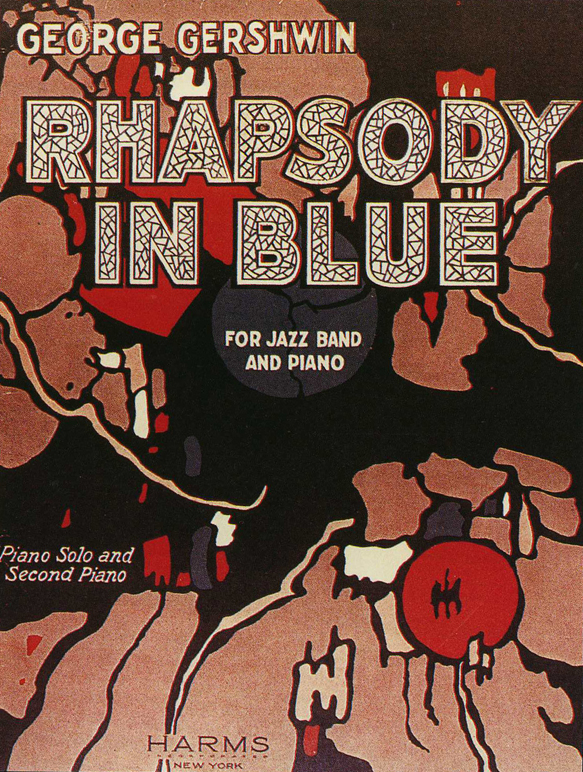
Rhapsody in Blue is a 1924 musical composition for solo piano and jazz band by George Gershwin. Commissioned by jazz band leader Paul Whiteman, the work combines elements of classical music with jazz-influenced effects and was premiered in a concert entitled "An Experiment in Modern Music" on February 12, 1924 at Aeolian Hall, New York City. Whiteman's group performed the rhapsody with Gershwin playing the piano. Whiteman's arranger Ferde Grofé/Ferde Grofé orchestrated the rhapsody several times, including the original 1924 music, the 1926 orchestral score, and the 1942 symphonic music.
The Rhapsody is one of Gershwin's most recognizable creations and a key composition that defined the jazz era. Gershwin's piece inaugurated a new phase in American musical history, established his reputation as a prominent composer, and became one of the most popular of all concert works. In American Heritage magazine, Frederick D. Schwartz argues that the famous opening clarinet glissando has become as recognizable by concert audiences as the beginning of Beethoven's Fifth Symphony.
The composer intended to call it "American Rhapsody," but the now-famous title was suggested by his brother Ira Gershwin, after their visit to an exhibition by the Impressionist painter James McNeill Whistler, whose paintings included titles such as "Nocturne in Black and White," "Arrangement in Gray and Black," and others. Originally scored for two pianos, the Rhapsody was orchestrated in 1924 for piano and jazz ensemble by Ferd Grofé, a European-trained professional musician working for Whiteman, who two years later also performed the now-famous version for piano and symphony orchestra.
Cuban Overture
Inspired by the music he heard on vacation in Havana in 1932 ("two hysterical weeks...without sleep"), Gershwin composed a short, impressionistic piece to provide a taste of Cuban rhythms to American audiences who had never been to the island. In an attempt to ensure authenticity, he brought a set of Cuban musical instruments with him when he returned to New York, and after completing the piece, originally titled RUMBA, he sketched them on the title page of his manuscript, also indicating where the instrumentalists should be on stage: "right in front of the conductor's desk."
The work under the title Rumba had its premiere at the now-demolished Lewisohn Stadium in New York on 16 August 1932, as part of Gershwin's programme with the New York Philharmonic conducted by Albert Coates. The concert was a huge success. As Gershwin wrote, "I really believe it was the most exciting night I ever had... 17,845 people paid to get in, and about 5,000 were at the closed gates trying to force their way in - unsuccessfully."
The composition was received favorably by critics. It was renamed Cuban Overture three months later at a benefit concert conducted by Gershwin at the Metropolitan Opera to avoid the public's perception that it was just something new. The new title provides, as the composer states, "a fairer idea of the character and intention of the music."
The opera Porgy and Bess
Brightness, significance, and a combination of classical and "black" jazz set Gershwin's style apart from the rest. The musician's mature period was in the 1930s, when his most famous opera, Porgy and Bess, was born.
The maestro himself came up with the idea in 1926 while reading Dubose Hayward's Porgy. Even then the composer could not sleep and considered the plot for the future masterpiece, but managed to start work on it much later due to the large number of other projects.
The opera was first staged in Boston in 1935 to great public acclaim. The endless enjoyment as well as the fact that people of different races attended the performance brought recognition to the author.
"Porgy and Bess - A Symphonic Picture"
In 1936, Gershwin shaped excerpts from the opera into the orchestral suite "Porgy and Bess," first performed by the Philadelphia Symphony Orchestra on January 21 of that year with the author in the keyboard part. Gershwin conducted all subsequent performances of the Suite until his death in 1937. But the work was then forgotten, and it was not until 1958 that Ira Gershwin's secretary found it, then titling it Catfish Row so as not to confuse it with the suite Porgy and Bess, a symphonic picture created in the meantime in 1942 by Robert Russell Bennett, a friend and collaborator of the composer.
Bennett brings together most of the best-known songs from the opera without following their chronology. And although some moments from the opera are missing, many of the most attractive melodies can only be heard in this suite, since Gershwin did not include them in Catfish Row, which focuses primarily on the spiritual aspect of the work. Fritz Rainer, conductor of the Pittsburgh Symphony Orchestra, also takes part in the arrangement. He determined the order of the movements and transposed individual moments, striving to keep the work to an exact 24-minute duration so that it could be recorded in three 78-rpm records. And although he excludes the piano, with its specific role in Gershwin's orchestration, the score as a whole is very closely related to the composer's original. The Symphonic Picture was first heard in concert by the Pittsburgh Symphony Orchestra in 1943.
The soloist
KONSTANTIN KOSTOV was born in 1979 in Vratsa. His first piano lessons were at the age of 5 at the Music School in Vratsa in the class of Peter Karagenov- composer and teacher. At the age of 11 he was already a soloist of the Vratsa Philharmonic Orchestra. In 1993-1998 he continued his studies at the Secondary Music School "Panayot Pipkov" in Pleven in the piano class of Eleonora Karamisheva. Here his love for composition and improvisation was born. He wrote music for various chamber ensembles, for string orchestra with soloists and some pieces were recorded and published.
Kostov chose the path of a jazz musician and was admitted in 1998 to the NMA "Prof. Pancho Vladigerov" in Sofia in the jazz piano class of Prof. Julia Tsenova. He is actively engaged in composition and improvisation.
After graduating from the Academy in Sofia, he was accepted at the Munich Music Academy as a student of one of the titans of jazz piano Prof. Leonid Cizik. The six-year period of study here had a great influence on Kostov's musical development.
In 2003 he was awarded the Grand Prix-Gasteig Competition. He also played at festivals such as Regensburg Jazzfest, Münchner Jazzfest, Jazz Segäwerk,Stainway Jazzfest and many others.
Peter O`'Mara,Leszek Zadlo, Duschko Goykovich,Guido May,Claus Reichstaller,Johannes Faber,Peter Tuscher and others. He graduated in 2007.
In 2008 he won the competition for Associate Professor of Jazz Piano at the Hochschule für Musik und Theater München, where he graduated and where he will teach until 2023. Alongside his teaching work, he has an active concert career.
In 2010 he won second prize and public prize at a competition in St. Petersburg - Terem Crossover Competition -Classic/Jazz. Concerts followed in halls such as: the Dmitry Shostakovich Philharmonic Hall in St. Petersburg, the small hall in the House of Composers - Moscow, the concert hall in Irkutsk and many others. He has performed a number of joint concerts in Russia with musicians such as Danil Kramer, Anatoly Krol, Igor Butman, Anna Valyullina.
Since 2007, Kostov has performed frequently in Japan at the Sapporo Jazzfest, Takatsuki Jazz Street, Tokushima Jazzfest, Blue Note-Nagoya, Kyoto - Jazz RAG, Yokohama Jazzfest and has performed at various clubs in Japan.
In the period from 2011 till now he has intensive concert activity in Poland with the musicians Agnieszka Heckiert, Cezary Konrad, Paweł Panta, Krzysztof Kubyszyn and others.
He has participated in festivals in Warsaw, Kraków, Lublin, Szczecin, Gdańsk, Opole, Kudowa, Nowy Sącz, Katowice and others. Very often, along with his concerts, he gives Jazz Piano Workshops at various schools and Academies.
He has performed with famous musicians such as Robby Ameen, also with Gregory Porter.
Since 2020 he has been actively writing symphonic music, as well as for the BNR Big Band.
He recorded a concerto for jazz piano as soloist and composer with the BNR Symphony Orchestra.
He realized a project with the BNR Big Band and the Kostov Trio - "Musorgsky - paintings from an exhibition" with his own arrangements.
He has given numerous concerts with the Pleven Philharmonic Orchestra throughout the country, where he played his concerto for jazz piano and orchestra.
Since 2021 he has been living back in Bulgaria and performing at numerous festivals as well as participating in various musical projects.
In 2024 he was awarded the Crystal Lyre of the Union of Bulgarian Music and Dance Artists as a pianist and composer - for excellence in the field of jazz.