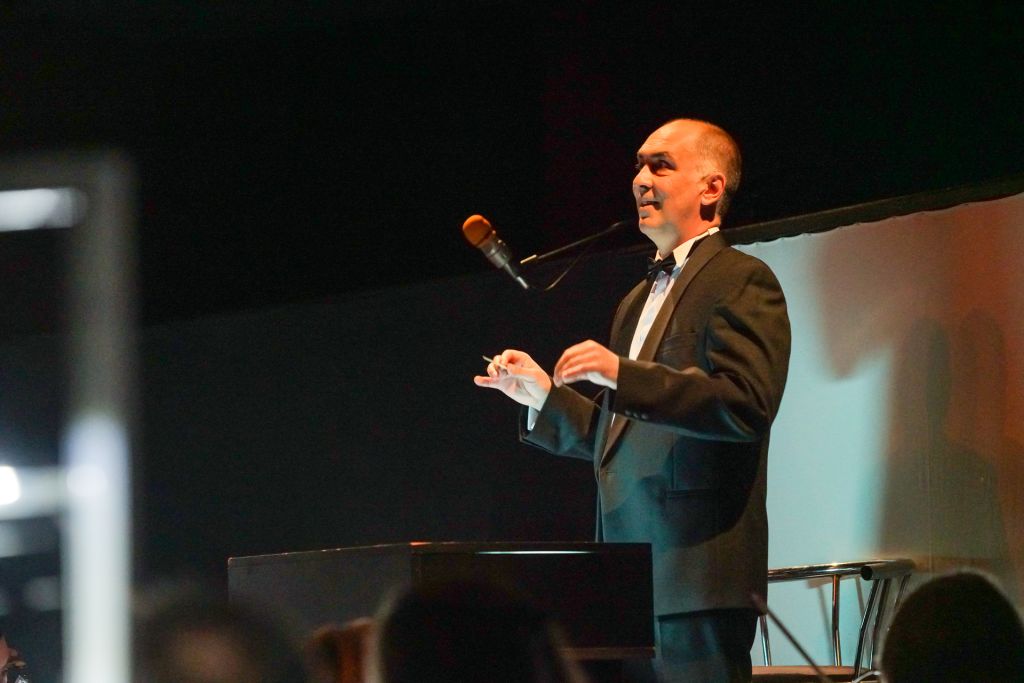
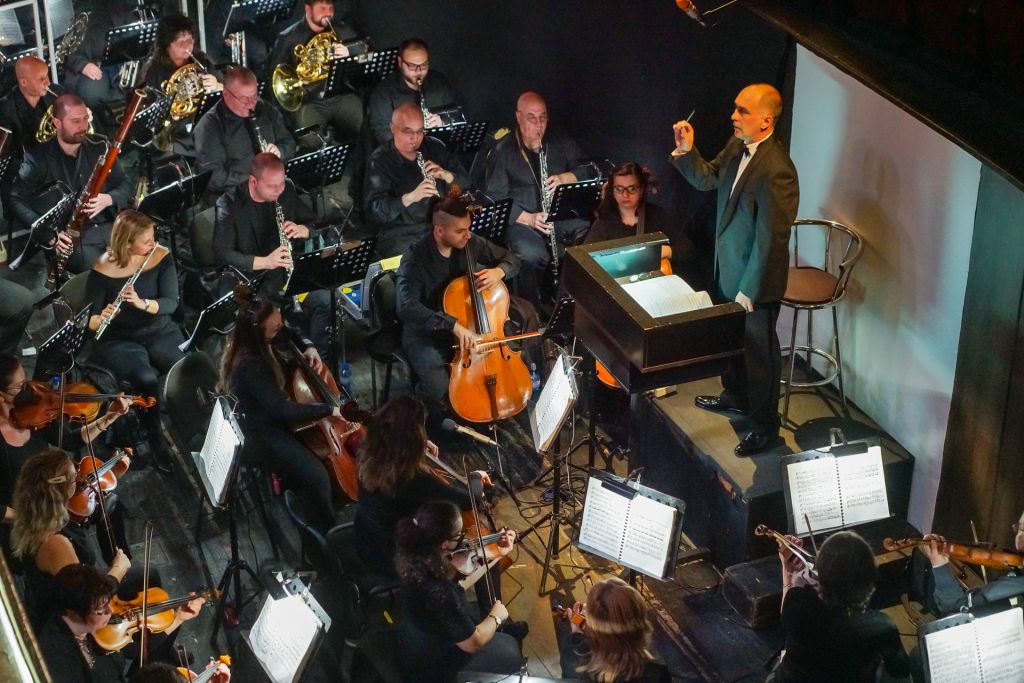
Conductor Vladimir Boshnakov: The music of Pilate's Dream is very evocative and vividly pictorial
News публикувана на: 06.10.2021
 Go back
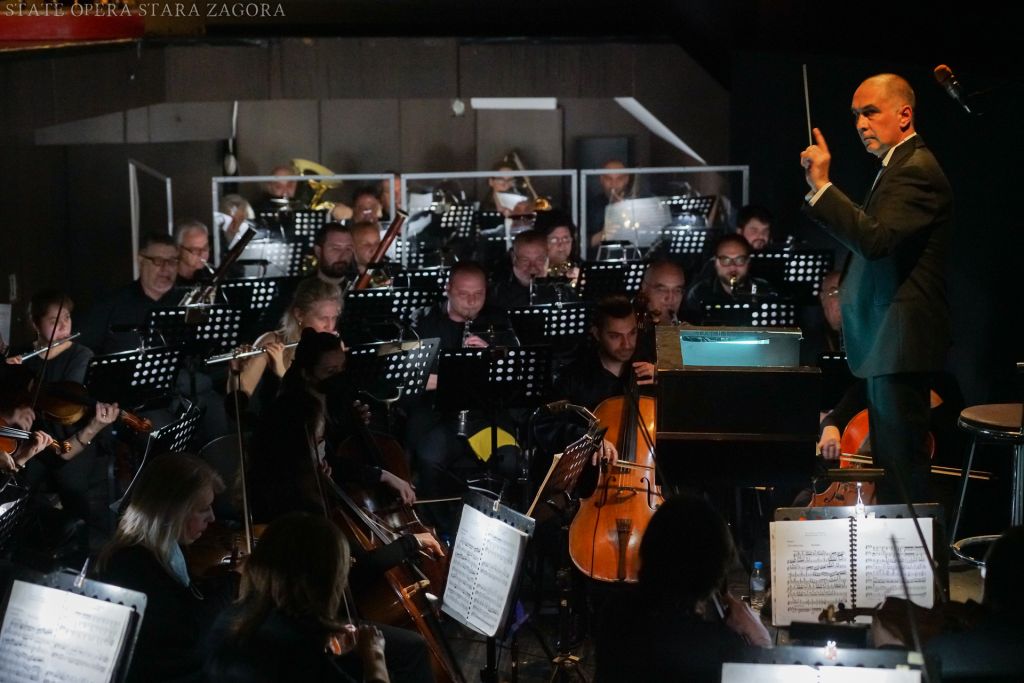
The conductor Vladimir Boshnakov:
The music of Pilate's Dream is very evocative and vividly pictorial.
"Pilate's Dream" ends with the belief that love continues in death...
The world premiere of the dance mystery "Pilate's Dream" will take place on October 16, at 7 pm on the stage of Hall 1 of the National Palace of Culture. The performance is realized by the Stara Zagora Opera, "Values" Foundation, Palms Music, with the support of the Ministry of Culture, Sofia Municipality and Stara Zagora Municipality.
The choreography of "Pilate's Dream" is fully staged with the multinational ballet troupe of the Stara Zagora Opera by the world ballet master Vasily Medvedev and his assistant Stanislav Fecho, final touches on the costumes and set design are put by the artist Pavol Jurash, intensive musical rehearsals of the choir and orchestra are underway under the expert guidance of conductor Vladimir Boshnakov. We tear the Maestro away from his complete immersion in the score for a moment to find out more about Stefan Dimitrov's music in Pilate's Dream.
Maestro Boshnakov, can you tell us in a few words, describe the music of the ballet Pilate's Dream?
- In a few words it would not be very easy. The music of Pilate's Dream is very evocative and vividly pictorial. Everyone may know the work of Stefan Dimitrov - he is a melodic composer, his music is beautiful with its inherent lyricism. But the specificity that we are talking about here is a dance mystery, the musical construction of the characters in the ballet, the composer masterfully uses many other techniques.
- The ballet is structured in two acts - "Lux Aeterna" (Eternal Light) is the first movement and the second is " Misericordia Pro Nobis" (Mercy for Us). These are the two main acts, but inside there are many parts that expose the images of Marguerite, of the Master, of Mary Magdalene, of Jesus, of Pilate, of Voland.
- The theme of love is present from the beginning to the end of the ballet. It evolves thanks to its opposition to the negative forces and characters in the dance drama who try to prevent this love. And Pilate's Dream ends in this way - not with some kind of 'happy ending', but with the belief that love continues in death.
- In the ballet version, the performance ends with just such an adagio - an extremely beautiful theme that Stefan Dimitrov also developed as a song with lyrics that will perhaps be performed after the performance during the bowing.
- It is musically portrayed through the great contrasts between the parts, dictated of course by the great contrasts between the protagonists. The ballet begins in the present tense, and then the action moves back 2000 years, where the images of Mary of Magdala and Pontius Pilate appear. Surrealism is rather portrayed in the set design as well as the choreography of the dance, while the music only enriches and complements the plot of the ballet.
- For the love themes, Stefan Dimitrov uses delicate instruments such as flute and oboe, cello and violin. While for everything and everyone that opposes this love, he uses the instruments like bass clarinet, trumpets, trombones, tuba. I think purely musically he has definitely achieved that contrast between love and aggression.
- Plamen Velinov was a purely technical assistant to Stefan Dimitrov so that the composer's music, soul and expression could take on a version in which it could be orchestrated.
- At the climaxes of the movements the composer almost always adds the human voice, because he obviously needs it as a timbre, thus making the music even more evocative. The chorus is involved from the first to the last part of the ballet with a few exceptions, either with Latin texts or vocals only.
- The orchestra is impressed by the music - abstract and impactful on a subconscious level. I dare say that they all work with great pleasure on Stefan Dimitrov's score.
Vladimir Boshnakov graduated in 1990 from the Panayot Pipkov School of Music in his hometown of Pleven and in 1995 graduated as a Master of Music in Choral Conducting and Clarinet Performance from the National Academy of Music "Prof. Stefan Dimitrov". Pancho Vladigerov - Sofia. In 1999-2001 she specialized in opera and symphonic conducting in the class of prof. He studied orchestral conducting at the University of Sofia in 2001.
She made her debut on the stage of the Pleven Philharmonic with soloist prof. In 1996 he conducted the Philharmonic Orchestras in Pleven, Plovdiv, Shumen, Vidin, the chamber orchestra in Dobrich, the operas in Varna, Ruse, Stara Zagora, Burgas, Blagoevgrad and on the stage of the Musical-Dramatic Theatre "K. Kisimov Veliko Tarnovo. In 2002 - 2008 with the chamber orchestra Studio Primo he performed concerts with Vasko Vassilev, Svetlin Rusev, Yildiz Ibrahimova, Teodosii Spasov and others.
Chief conductor of the Musical-Dramatic Theatre "K. Kisimov Veliko Tarnovo (2005-2010) and Pleven Philharmonic (2011-2012). Since 2013 - conductor at the State Opera - Ruse, and since 2017 - at the State Opera - Stara Zagora. Artistic Director of the Festival "Stage of the Ages" since 2016.
He has toured extensively abroad in countries such as Austria, Germany, Luxembourg, the Netherlands, Switzerland, etc.
Maestro Boshnakov's repertoire includes titles such as Nabucco, La Traviata, Il Trovatore, Verdi's Aida, Tosca, Madame Butterfly, and Puccini's Turandot. "Maria Dessislava" by P. Khadzhiev, the ballet by P. Tchaikovsky's "Sleeping Beauty" and many others.
Interview by Uliana Kyoseva